Japandi is a design style that blends Japanese minimalism with Scandinavian coziness. It strips a room down to what matters, then makes every remaining piece feel intentional and warm. The result is a home that feels both calm and lived-in — never cold, never cluttered.
Two philosophies sit at the core of this style. Japanese design brings wabi-sabi (the beauty of imperfection and impermanence) and a deep respect for natural materials. Scandinavian design contributes hygge (a sense of coziness and comfort) and the belief that everyday objects should be beautiful as well as functional. Together, they create a design language that resonates with people who want less stuff but more meaning in their spaces.
Key Takeaways
- Japandi blends wabi-sabi and hygge — two philosophies that value imperfection, comfort, and purposeful living.
- The color palette stays neutral and earthy — warm whites, soft grays, muted greens, and deep charcoal anchor the aesthetic.
- Every piece must earn its place — Japandi avoids decorative objects that serve no function or emotional purpose.
- Natural materials are non-negotiable — wood, linen, bamboo, stone, and ceramic define the texture of the style.
- Low, grounded furniture is a hallmark — pieces sit close to the floor, creating a sense of ease and visual calm.
- Japandi works in any room — living rooms, bedrooms, kitchens, and bathrooms all respond well to its principles.
- You don’t need a full renovation — thoughtful swaps in color, materials, and clutter reduction can shift any room toward Japandi.
What Exactly Is Japandi Interior Design?
Quick Answer: Japandi is a hybrid design style combining Japanese minimalism and Scandinavian simplicity. It emphasizes natural materials, neutral color palettes, functional furniture, and a philosophy of intentional living. Rooms feel quiet, warm, and uncluttered.
The word “Japandi” is a portmanteau — Japan plus Scandi. It emerged as a formal design trend around 2017 but draws on a cultural exchange between Japan and Scandinavia that dates back centuries. Both regions share an appreciation for craft, restraint, and the idea that beauty lives in simplicity.
What makes Japandi distinct from pure minimalism is warmth. Pure minimalism can feel sterile. Japandi softens that edge with texture, natural imperfection, and comfort. A bare concrete floor feels cold. A bare concrete floor with a low oak bench, a handmade ceramic bowl, and a linen cushion feels like Japandi.
How Does Japandi Differ From Japanese Minimalism?
Japanese minimalism prioritizes emptiness as a design element. Negative space is intentional. Japandi keeps that sensibility but layers in Scandinavian warmth — softer textiles, slightly more furniture, and a focus on making the space feel livable rather than purely austere.
How Does Japandi Differ From Scandinavian Design?
Scandinavian design (sometimes called “Scandi”) leans into functionality and clean lines but can incorporate brighter whites, lighter woods, and more decorative elements. Japandi pulls the palette darker, adds Japanese asymmetry, and brings in materials like bamboo, washi paper, and matte ceramics that are distinctly East Asian in origin.
What Are the Core Principles of Japandi Design?
Quick Answer: Japandi’s five core principles are: embrace imperfection (wabi-sabi), prioritize function, use natural materials, keep a neutral and earthy color palette, and cultivate intentional simplicity. Every design decision filters through at least one of these lenses.
Wabi-Sabi: Finding Beauty in Imperfection
Wabi-sabi is a Japanese worldview that finds beauty in things that are imperfect, incomplete, or impermanent. In a Japandi room, this shows up as a handthrown ceramic mug with an uneven rim, a wooden side table with visible grain and knots, or a linen throw that softens and wrinkles with use.
Wabi-sabi directly opposes the idea of a “showroom perfect” space. The goal is not pristine — it is genuine. Objects should look like they have been touched, used, and loved.
Hygge: Comfort as a Design Goal
Hygge (pronounced “hoo-gah”) is a Danish and Norwegian concept that translates roughly to coziness and contentment. In design terms, it means creating spaces where people feel at ease. Soft lighting, tactile materials, and furniture arranged for conversation all contribute to hygge.
In Japandi, hygge prevents the space from feeling sparse or unwelcoming. It is the reason a Japandi living room has a thick wool rug, candles, and a well-placed reading chair — even if everything else is stripped back.
Ma: Intentional Negative Space
Ma is a Japanese concept meaning “negative space” or “pause.” In design, it refers to the deliberate use of empty areas to give the eye and the mind a place to rest. Japandi rooms never feel packed. There is always breathing room between furniture pieces, artwork, and objects on shelves.
What Colors Define the Japandi Palette?

Quick Answer: Japandi uses warm neutrals, earthy mid-tones, and deep anchoring shades. Think warm white, soft beige, warm gray, sage green, terracotta, and charcoal. The palette avoids stark whites and bright colors, staying muted and grounded throughout.
| Color | Role in Space | Best Application | Avoid Pairing With |
|---|---|---|---|
| Warm White (e.g., Farrow & Ball “All White”) | Primary wall color | Walls, ceilings | Bright primary colors |
| Warm Gray / Greige | Secondary neutral | Walls, large upholstery | Cool blues or silvers |
| Sage Green | Nature-inspired accent | Cushions, ceramics, feature wall | Bright yellow or orange |
| Warm Charcoal / Sumi Black | Grounding anchor | Furniture legs, frames, fixtures | Bright white (too stark) |
| Terracotta / Clay | Warm earthy accent | Ceramics, textiles, small decor | Pastels or neons |
| Natural Wood Tones (walnut, oak) | Material color, warmth | Floors, furniture, shelving | Painted or lacquered finishes |
The palette works because every color in it could exist in nature. Nothing is synthetic or electric. When you stand in a Japandi room, the colors feel like you stepped outside — muted sky, bare earth, dry grass, dark stone.
What Materials Are Essential to Japandi Style?

Quick Answer: Japandi relies on natural, tactile materials. The most common are solid wood (walnut, oak, bamboo), linen and cotton textiles, stone and concrete surfaces, handmade ceramics, washi paper, and natural fiber rugs like jute or seagrass.
| Material | Origin Influence | Common Application | Key Attribute | Approximate Cost Range |
|---|---|---|---|---|
| Solid Oak | Scandinavian | Furniture, flooring | Light grain, durable, ages well | $200–$2,000+ per piece |
| Walnut | Both | Furniture, shelving | Dark warm grain, premium look | $400–$3,500+ per piece |
| Bamboo | Japanese | Flooring, trays, blinds | Renewable, strong, fine grain | $2–$8 per sq ft (flooring) |
| Linen | Scandinavian | Upholstery, throws, cushions | Breathable, natural texture, wrinkles intentionally | $15–$60 per yard |
| Handmade Ceramic | Japanese | Vases, bowls, mugs | Imperfect form, matte glaze | $20–$300+ per piece |
| Natural Stone / Slate | Both | Countertops, tiles, trays | Unique veining, cool surface | $50–$200 per sq ft (installed) |
| Jute / Seagrass Rug | Neutral | Area rugs, layering | Coarse texture, earthy tone | $80–$600 depending on size |
Avoid synthetic materials whenever possible. Plastic, chrome, and glossy lacquered finishes break the tactile warmth that Japandi depends on. If budget is a constraint, prioritize natural materials in the most-touched surfaces — cushions, handles, rugs, and tabletops.
What Does Japandi Furniture Look Like?
Quick Answer: Japandi furniture is low-profile, functional, and made from natural materials. Pieces have clean lines without harsh edges. Common forms include platform beds, low sofas, slatted benches, and open shelving. Dark walnut and light oak are the dominant finishes.
Key Furniture Characteristics
- Low to the ground: Platform beds, floor cushions, and low coffee tables create a grounded, restful feel.
- Clean silhouettes: No ornate carvings, no fussy hardware. Handles are minimal or absent.
- Exposed joinery: Visible dovetail joints or wooden pegs reflect the wabi-sabi appreciation for honest construction.
- Dual purpose: Storage ottomans, benches with shelves, and beds with drawers reflect the Scandinavian obsession with function.
- Tapered or splayed legs: A nod to mid-century Scandinavian design, this detail keeps furniture from looking heavy.
Which Furniture Brands Align With Japandi Aesthetics?
| Brand | Country of Origin | Price Range | Japandi-Relevant Strengths |
|---|---|---|---|
| Muji | Japan | $–$$ | Minimal forms, natural materials, functional storage |
| HAY | Denmark | $$–$$$ | Clean Scandi lines, solid wood options, muted palette |
| Karimoku | Japan | $$$–$$$$ | Premium solid wood, joinery-forward, heirloom quality |
| IKEA (selected lines) | Sweden | $ | STOCKHOLM and SINNERLIG ranges fit Japandi principles at entry price |
| CB2 | USA | $$–$$$ | Low-profile sofas, walnut finishes, clean hardware |
| Article | Canada | $$ | Mid-century Scandi-influenced shapes, solid wood legs |
How Do You Apply Japandi Design Room by Room?

Quick Answer: Apply Japandi room by room by focusing on one neutral wall color, selecting one or two natural wood tones, reducing objects to only what is functional or meaningful, and adding texture through linen, ceramics, and natural fiber rugs. Each room needs breathing space.
Japandi Living Room
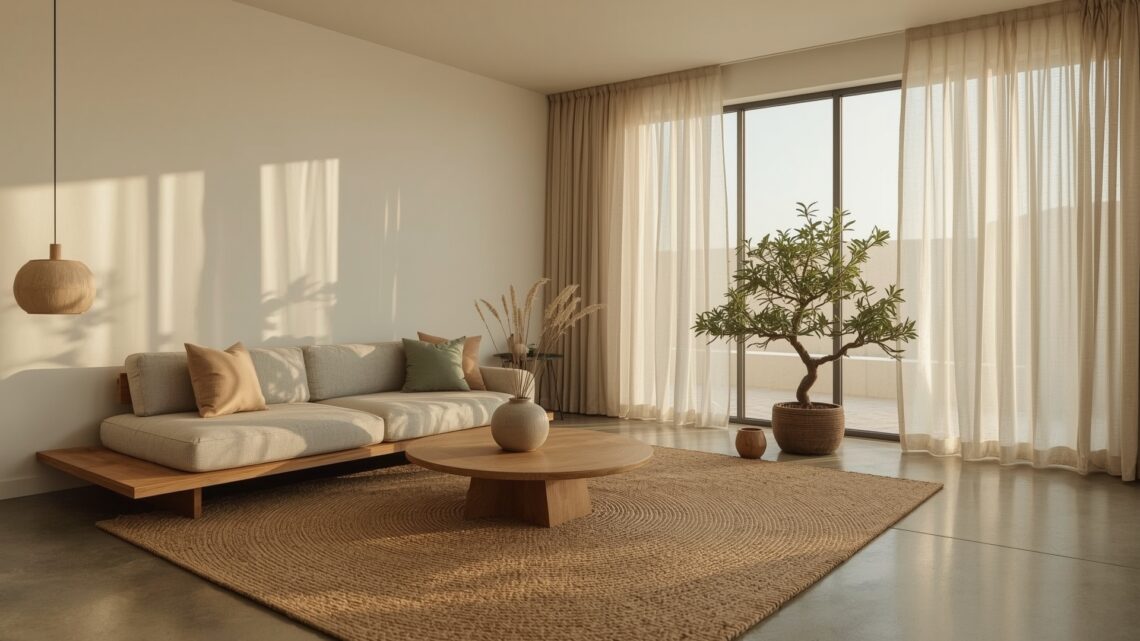
The living room is where Japandi’s balance of simplicity and comfort is most visible. Start with a low sofa in a neutral fabric — warm gray linen or oatmeal boucle work well. Pair it with a low walnut coffee table and a single floor lamp with a washi paper shade.
Keep the shelving open but disciplined. Three or four objects on a shelf is a still life. Ten objects is clutter. Choose a handmade ceramic vase, a small potted plant, and one book turned cover-out. Let the shelf breathe.
Japandi Bedroom
The bedroom is where Japandi’s grounding effect is most powerful. A platform bed with a solid wood frame sits low and anchors the room. Layer bedding in natural linen — start with white or warm gray, then add a textured knit throw in charcoal or sage.
Nightstands should be minimal. A single drawer, a small lamp, and one object — a ceramic cup, a single stem in a bud vase — is enough. Avoid overhead lighting if possible; wall sconces or paper lanterns create a softer, more intimate light quality.
Japandi Kitchen
In the kitchen, Japandi translates to handleless cabinets in warm white or soft sage, open shelving for everyday ceramics, and a stone or concrete countertop. Matte black or brushed brass fixtures add contrast without breaking the palette.
Keep the countertop as clear as possible. Store appliances out of sight. Display only what is used daily — a ceramic crock with wooden utensils, a simple cutting board, a small plant. The kitchen should look like a place where someone cooks thoughtfully, not a showroom.
Japandi Bathroom
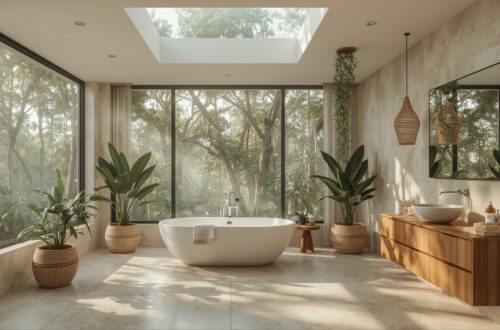
A Japandi bathroom draws from Japanese onsen (hot spring bath) culture. Think deep soaking tubs, wooden bath mats (hinoki wood is traditional), stone basins, and careful lighting. The walls stay neutral — warm white tile or large-format slate gray stone.
Add a bamboo stool, a linen hand towel in natural or soft sage, and a single plant like a small fern. Avoid colorful bottles on the counter. Decant products into simple ceramic or glass containers to maintain visual calm.
What Lighting Works Best in a Japandi Space?
Quick Answer: Japandi lighting stays warm and layered. Use warm-toned bulbs between 2,700K and 3,000K. Washi paper pendants, rattan shades, and concrete floor lamps fit the material palette. Avoid cool white light, which breaks the warmth of the aesthetic.
Lighting Layers for a Japandi Room
- Ambient: A central pendant in washi paper or rattan provides soft, diffused light. Avoid recessed downlights, which are too bright and directional.
- Task: A single adjustable wall sconce or table lamp in ceramic or concrete for reading and close work.
- Accent: Candles or a small LED candle insert in a ceramic holder add flickering warmth in the evening.
Color temperature matters enormously in a Japandi space. Warm white bulbs (2,700K to 3,000K) make wood tones glow and neutral walls feel inviting. Daylight bulbs (5,000K+) strip that warmth away and make the room feel clinical.
How Do You Decorate a Japandi Space Without Cluttering It?
Quick Answer: Japandi decoration follows the rule of intentionality — every object must be functional, beautiful, or meaningful, ideally all three. Use the “odd number” principle for shelf styling, rotate seasonal objects rather than accumulating, and give every piece a clear visual pause around it.
The Japandi Approach to Art and Wall Decor
Japandi rooms rarely use gallery walls. One large piece of art, placed with deliberate spacing, has more impact than a dozen smaller ones. Japanese woodblock prints, abstract ink paintings, and simple botanical photography all fit the aesthetic.
Leave wall space intentionally bare. The empty wall beside a piece of art is part of the composition. This is the concept of ma applied to two dimensions.
Plants in a Japandi Interior
Plants are essential but restrained. A single large plant — a fiddle leaf fig, a snake plant, or a sculptural bonsai — makes more of a statement than a collection of small pots. Choose ceramic or handmade clay pots that match the earth-tone palette.
Avoid plastic pots and ornate planters. The container is part of the design, not just a vessel.
How Do You Start Transitioning Your Home to Japandi?
Quick Answer: Start by removing objects that are neither functional nor meaningful. Then audit your color palette and replace synthetic materials with natural ones. You don’t need to buy new furniture — editing what you own, repainting walls, and swapping textiles gets you 80% of the way there.
A Practical Step-by-Step Transition Plan
- Declutter ruthlessly. Remove anything you don’t use or genuinely love. If it’s just filling a gap, it goes.
- Audit your palette. Identify colors that feel out of place. Start painting the most-used room a warm neutral.
- Swap your textiles first. Replace synthetic cushion covers, throws, and curtains with linen, cotton, or wool alternatives. This is the fastest, most affordable shift.
- Edit your shelves. Take everything off. Put back only three to five objects per shelf. Leave visible space between them.
- Replace one key piece of furniture. A platform bed, a low coffee table, or a solid wood bench can anchor an entire room in the Japandi direction.
- Address your lighting. Switch bulbs to warm white (2,700K). Add one lamp with a natural material shade.
- Introduce one handmade object. A ceramic vase, a wooden bowl, or a handwoven basket brings the wabi-sabi principle to life.
What to Avoid When Building a Japandi Space
- Too many plants competing for the eye’s attention
- Mixing too many wood tones (stick to two maximum)
- Matching sets that look like a catalog page (slight variation reads as intentional curation)
- Decorative objects without meaning or function
- Overusing black (it anchors but does not dominate in Japandi)
- Ignoring texture (a room in all neutrals falls flat without tactile variation)
What Is the Difference Between Japandi and Wabi-Sabi Style?
Quick Answer: Wabi-sabi is a philosophy; Japandi is a design style. Wabi-sabi informs Japandi but goes further in embracing decay, asymmetry, and raw incompletion. A Japandi room is livable and comfortable. A pure wabi-sabi space may feel more austere, weathered, and intentionally unfinished.
Think of wabi-sabi as the philosophical ancestor of Japandi. A cracked ceramic bowl repaired with gold (kintsugi) is pure wabi-sabi. A smooth handthrown ceramic bowl with an uneven rim is Japandi. Both honor imperfection, but Japandi keeps it subtle enough for a family home.
Is Japandi Design Sustainable?
Quick Answer: Japandi design aligns naturally with sustainability. Its emphasis on quality over quantity, natural materials, and long-lasting furniture means fewer replacements and less waste. Buying fewer, better pieces is more sustainable than refreshing a space with cheap, trend-driven furniture every few years.
The “buy once, buy well” mindset that runs through both Japanese and Scandinavian craft traditions directly supports sustainable consumption. A solid walnut dining table bought once and handed down is more sustainable than three generations of flat-pack replacements. Look for FSC-certified wood (an independent certification that ensures timber comes from responsibly managed forests) and natural fiber textiles when sourcing.
Japandi also discourages fast furniture cycles. The style values pieces that age beautifully rather than ones that go out of fashion. That built-in longevity is a sustainable design choice in itself.
Frequently Asked Questions About Japandi Interior Design
Is Japandi the same as minimalism?
Japandi is not pure minimalism. It shares minimalism’s preference for uncluttered spaces but adds warmth through natural materials, soft textiles, and the hygge principle of coziness. Minimalism can feel cold; Japandi feels intentionally livable.
What is the easiest way to add Japandi style to a rental?
Swap your textiles first. Linen curtains, a natural fiber rug, and a few handmade ceramics cost little and require no landlord approval. Then edit your surfaces — remove anything on counters and shelves that isn’t functional or meaningful.
Can Japandi work in a small apartment?
Japandi works particularly well in small spaces. The emphasis on low furniture, negative space, and a tight color palette prevents visual crowding. Fewer, better pieces in a small apartment feel more spacious than the same room stuffed with furniture.
What is kintsugi and how does it relate to Japandi?
Kintsugi is the Japanese art of repairing broken ceramics with gold lacquer. It celebrates the history of an object rather than hiding its damage. In Japandi spaces, a kintsugi-repaired bowl on a shelf embodies the wabi-sabi principle that imperfection holds beauty.
How much does it cost to furnish a Japandi living room?
A Japandi living room can be achieved at almost any budget. An IKEA-based setup using the STOCKHOLM range and linen cushion covers can run $800 to $2,000. A mid-range approach with Article or CB2 furniture runs $3,000 to $7,000. Premium setups using Karimoku or HAY pieces can exceed $15,000.
Does Japandi style allow any color beyond neutrals?
Yes, but cautiously. Muted accent colors — soft sage green, clay terracotta, dusty blue-gray — are entirely appropriate. The rule is that any color you add should look like it could occur in nature and should appear in small doses, typically in textiles or ceramic accessories.