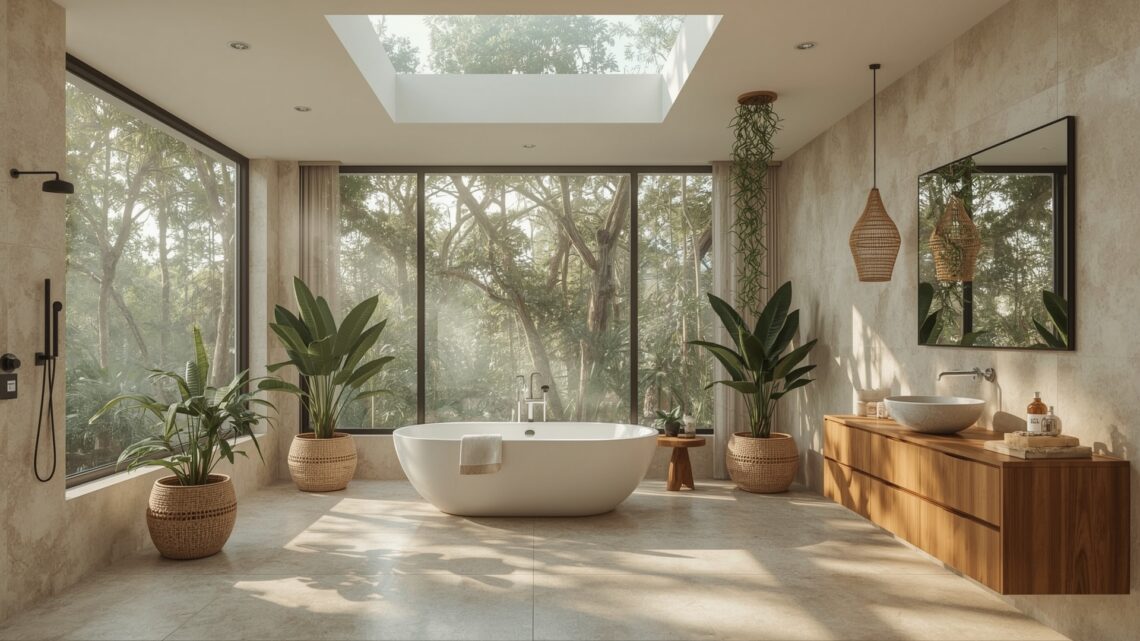
Your bathroom is one of the most personal rooms in your home. It’s where you start and end your day. Biophilic bathroom design turns that daily ritual into something restorative by bringing natural materials, living plants, water features, and daylight into a single cohesive space.
Biophilic design (the practice of connecting indoor spaces to nature through materials, light, and living elements) works especially well in bathrooms. The room already has water. It already encourages slowing down. Adding natural stone, greenery, and organic textures builds on that foundation rather than fighting it.
This guide covers every design vector: materials, plants, lighting, fixtures, layout, and sensory details. By the end, you’ll have a clear picture of how to apply each principle in a real bathroom, whether you’re renovating fully or making targeted upgrades.
Key Takeaways
- Natural stone tile and wood-look surfaces are the fastest way to ground a bathroom in biophilic materials.
- Humidity-tolerant plants like pothos, ferns, and orchids thrive in bathrooms with indirect light and steam.
- Rain showers and freestanding tubs mimic natural water experiences and are central fixtures in biophilic wet room design.
- Natural light strategies (skylights, frosted glass, light tubes) dramatically improve the connection to the outdoors in windowless or small bathrooms.
- Sensory layering (sound, scent, texture) completes the biophilic experience beyond just visual design.
- Wet room layouts with open, barrier-free showers are ideal for integrating plants and stone surfaces without visual clutter.
What Makes a Bathroom Design Truly Biophilic?
Quick Answer: A biophilic bathroom uses natural materials, living plants, real daylight, and water features to create a direct sensory connection to nature. It goes beyond “earthy colors” by incorporating actual organic elements like stone, wood, and live greenery.
Biophilic design is not an aesthetic trend. It’s rooted in the biophilia hypothesis, which suggests humans have an instinctive need to connect with natural environments. In bathrooms, that connection reduces stress and supports the restorative function the room is meant to serve.
There are three core pillars: direct nature connection (plants, water, natural light), indirect nature connection (natural materials, organic shapes, nature-inspired patterns), and spatial conditions (views of nature, refuge-like enclosure, sensory variety). A genuinely biophilic bathroom touches all three.
What Separates Biophilic Design From Just “Natural-Looking” Decor?
Faux wood tiles and plastic greenery create an aesthetic impression. Biophilic design requires real materials and real living elements. The sensory signals from actual stone, running water, and living plants trigger different neurological responses than their synthetic substitutes.
That said, real materials don’t mean expensive. Travertine is more affordable than marble. Pothos costs under $10. The commitment is to authenticity, not luxury price points.
Which Natural Stone Tiles Work Best in a Bathroom?

Quick Answer: Travertine, slate, and limestone are the most practical natural stone tiles for bathrooms. They handle moisture well, offer strong slip ratings when honed or textured, and cost less per square foot than marble. Each creates a distinct organic texture.
Natural stone is the most impactful single material choice in a biophilic bathroom. It introduces visual variation (no two tiles are identical), tactile texture, and a direct reference to geological processes that span thousands of years. That’s a depth of connection no ceramic imitation can replicate.
Natural Stone Tile Comparison for Bathrooms
| Stone Type | Cost Per Sq Ft (Installed) | Slip Rating (Wet) | Porosity Level | Maintenance Frequency | Best Application |
|---|---|---|---|---|---|
| Travertine | $12–$25 | R10–R11 (honed) | High (requires sealing) | Seal every 12–18 months | Floor, feature wall |
| Slate | $10–$22 | R11–R12 | Low to medium | Seal every 2–3 years | Shower floor, wet room floor |
| Limestone | $15–$30 | R9–R10 (honed) | High (very porous) | Seal every 12 months | Wall tile, vanity surround |
| Marble | $25–$60 | R9 (polished), R11 (honed) | Medium | Seal every 6–12 months | Feature wall, freestanding tub surround |
| Granite | $18–$35 | R10–R12 | Low | Seal every 1–2 years | Countertop, shower bench |
Porosity matters most in wet rooms. High-porosity stones like travertine and limestone need penetrating sealers applied before first use and reapplied regularly. Slate and granite are denser and more forgiving with maintenance.
How Should You Use Stone on Walls vs. Floors?
On floors, prioritize slip resistance over aesthetics. Honed, brushed, or tumbled finishes grip wet feet better than polished surfaces. Use larger format stones (12×24 inches or 24×24 inches) on walls to reduce grout lines and create a cleaner visual plane. Reserve polished or book-matched stone for feature walls where it won’t be walked on.
What Are the Best Humidity-Tolerant Plants for Biophilic Bathrooms?

Quick Answer: Pothos, Boston ferns, orchids, peace lilies, and snake plants all thrive in bathroom humidity levels of 50–80%. Most need indirect light. They improve air quality, add living texture, and reinforce the natural connection that defines biophilic design.
Plants are the most emotionally direct biophilic element you can add to a bathroom. They signal living ecosystems. They move slightly with air currents. They change subtly over time. That dynamic quality is something no material or fixture can replicate.
Bathroom Plant Selection by Light and Humidity
| Plant | Light Need | Humidity Tolerance | Watering Frequency | Max Height | Best Placement |
|---|---|---|---|---|---|
| Pothos (Epipremnum aureum) | Low to indirect | 50–80% | Every 7–10 days | Trailing to 10 ft | High shelf, hanging planter |
| Boston Fern (Nephrolepis exaltata) | Indirect bright | 60–80% | Every 5–7 days | 2–3 ft spread | Pedestal, window ledge |
| Orchid (Phalaenopsis) | Bright indirect | 50–70% | Every 10–14 days | 1.5–2 ft | Vanity counter, windowsill |
| Peace Lily (Spathiphyllum) | Low to medium indirect | 40–70% | Every 7–10 days | 1–4 ft | Corner floor planter |
| Snake Plant (Sansevieria) | Low to bright indirect | 30–70% | Every 14–21 days | 2–4 ft | Floor, corner, beside tub |
| Bird’s Nest Fern (Asplenium nidus) | Low to medium indirect | 60–80% | Every 5–7 days | 1.5–2 ft | Shower niche (no direct spray) |
The shower niche is an underused planting zone. A bird’s nest fern or small air plant placed in a recessed niche absorbs ambient steam without sitting in direct water. Make sure the niche isn’t in the direct path of the showerhead.
How Do You Keep Bathroom Plants Alive Long-Term?
The two most common failure points are overwatering and insufficient light. Steam from showers raises humidity but doesn’t substitute for actual watering. Check soil moisture with your finger before watering rather than following a fixed schedule. If your bathroom has no window, install a small grow light (1000–2000 lux is enough for low-light species) on a timer for 10–12 hours daily.
How Does a Rain Shower Enhance the Biophilic Experience?
Quick Answer: A rain shower replicates the sensory experience of natural rainfall. The overhead flow pattern, sound, and thermal sensation trigger the same calming neurological response as natural water. It’s a direct biophilic water feature built into your daily routine.
Water is one of the most powerful biophilic cues. Humans are drawn to it instinctively. Rain showers don’t just deliver water more evenly than standard showerheads. They change the sensory profile of the entire shower experience.
Rain Shower Specifications and Placement Options
| Specification | Ceiling-Mount | Wall-Mount Arm | Overhead Panel |
|---|---|---|---|
| Head Diameter | 8–16 inches | 8–12 inches | 16–24 inches |
| Optimal Ceiling Height | 8 ft minimum | 7 ft minimum | 8–10 ft |
| Flow Rate | 1.8–2.5 GPM | 1.8–2.5 GPM | 2.0–3.5 GPM |
| Water Pressure Required | 45–80 PSI | 40–60 PSI | 50–80 PSI |
| Installation Complexity | High (ceiling plumbing) | Low to medium | High (multiple inlets) |
| Biophilic Effect | Maximum (full immersion) | Good | Maximum (full body coverage) |
Ceiling-mount rain showers require rough-in plumbing during a remodel. If you’re working with an existing bathroom, a wall-mount arm extension (12–18 inches) that tilts the showerhead to overhead position gives you most of the experience without opening the ceiling.
Should You Pair a Rain Shower With an Open Wet Room Layout?
Yes. A wet room (a fully waterproofed, barrier-free shower space) removes the visual and physical boundary between the shower zone and the rest of the bathroom. This open format works naturally with large-format stone flooring, in-wall plants, and wood accents. The absence of a glass enclosure also lets the sound of the rain shower carry through the room, which is itself a biophilic sensory cue.
How Do You Choose a Freestanding Tub for a Biophilic Bathroom?

Quick Answer: Stone resin and cast iron freestanding tubs best support biophilic design. Stone resin tubs have an organic mineral texture and retain heat for 30–45 minutes. Cast iron tubs are durable and ground the room with visual weight. Both pair naturally with stone tile and wood accents.
A freestanding tub is a focal point. In a biophilic bathroom, it anchors the room the way a rock formation anchors a garden. The material and shape you choose broadcasts the design language of the entire space.
Freestanding Tub Materials for Biophilic Design
| Material | Weight (Average) | Heat Retention | Price Range | Biophilic Quality | Maintenance |
|---|---|---|---|---|---|
| Stone Resin (composite mineral) | 150–300 lbs | 35–45 min | $1,500–$5,000 | High (mineral texture, organic forms) | Non-porous, wipe clean |
| Cast Iron (porcelain enamel) | 250–500 lbs | 40–60 min | $1,000–$4,000 | Medium-high (weight, permanence) | Durable, chip-resistant |
| Acrylic | 50–100 lbs | 10–20 min | $400–$2,000 | Low (plastic material) | Easy, scratches over time |
| Copper | 150–250 lbs | 30–45 min | $2,000–$8,000 | High (natural patina, metallic earth tone) | Develops patina, no harsh cleaners |
Shape matters as much as material. Oval and curved silhouettes reference natural forms (river stones, pools, pebbles). Rectangular slipper tubs read as more architectural. For a fully biophilic bathroom, lean toward rounded or asymmetric forms.
Where Should a Freestanding Tub Be Positioned in a Biophilic Bathroom?
Position the tub so it receives natural light, ideally from a side window or skylight above. A tub placed beneath a skylight creates a direct visual and thermal connection to the sky. If the bathroom faces a private outdoor area, positioning the tub toward a full-height window or glass door creates the strongest nature connection of any placement option.
What Natural Light Strategies Work Best in Bathrooms?
Quick Answer: Skylights, solar tubes, frosted clerestory windows, and interior light wells are the most effective natural light strategies for bathrooms. They deliver daylight without sacrificing privacy. A single skylight can provide 30–40% of a bathroom’s daytime lighting needs.
Natural light is the most biophilic element you can introduce into any room, and it’s the one most bathrooms get wrong. Privacy concerns push designers toward small, frosted windows. But there are multiple ways to bring in real daylight without exposure.
Natural Light Options for Private Bathrooms
Skylights: Fixed or operable skylights placed above the shower or tub zone deliver direct natural light without any line-of-sight privacy issue. An operable skylight also allows steam ventilation, reducing moisture buildup that harms both plants and materials.
Solar tubes (tubular daylighting devices): A solar tube captures sunlight through a rooftop dome and routes it down a highly reflective tube into the room below. A 10-inch tube delivers roughly 150–300 watts equivalent of natural light. It’s a low-cost solution for bathrooms directly beneath a roof.
Frosted clerestory windows: Clerestory windows are positioned above the normal sightline, near the ceiling line. Frosted or patterned glass diffuses light while blocking direct views. They work especially well on exterior walls shared with a garage or exterior utility space.
Interior borrowed light: If the bathroom shares a wall with a light-filled room, a frosted glass panel or interior window (positioned high on the wall) borrows daylight without compromising privacy.
How Should You Layer Artificial Light to Support Biophilic Design?
When natural light isn’t available, tunable LED lighting (fixtures that shift from warm 2700K in the morning to cooler 4000K midday tones) maintains a circadian rhythm connection. Avoid flat, overhead-only lighting. Layer three sources: ambient (ceiling), task (vanity), and accent (under-bench, behind mirrors, or directed at stone feature walls).
Warm amber tones (2700K–3000K) in the evening create the same psychological effect as candlelight or firelight. Both are instinctive human comfort cues rooted in natural environments.
How Can Wood and Other Organic Materials Be Used Safely in a Wet Bathroom?
Quick Answer: Teak, iroko, and thermally modified ash are the most moisture-resistant wood species for bathrooms. They work safely as shower benches, floating vanities, and ceiling accents when sealed with marine-grade or penetrating oil finishes. Avoid untreated pine or MDF in wet zones.
Wood in a bathroom feels deeply biophilic. It introduces warmth, grain variation, and a biological reference that stone alone can’t deliver. The risk (warping, mold, rot) is real but manageable with correct species selection and finish.
Wood Species Suitability for Bathroom Applications
| Wood Species | Natural Oil Content | Janka Hardness | Safe Wet Zone Application | Recommended Finish | Approx. Cost Per Linear Ft |
|---|---|---|---|---|---|
| Teak | Very high | 1,155 lbf | Shower bench, wet floor slats | Teak oil every 6–12 months | $12–$20 |
| Iroko | High | 1,260 lbf | Shower bench, vanity top | Danish oil, reapply yearly | $8–$15 |
| Thermally Modified Ash | Modified (low natural) | 1,160 lbf | Ceiling, wall panels, bench | Oil or leave unfinished | $10–$18 |
| Cedar (Western Red) | Medium | 350 lbf | Ceiling panels, sauna-style accents | Penetrating oil sealer | $5–$10 |
| Bamboo (strand-woven) | Low (dense structure) | 3,000+ lbf | Flooring outside wet zone, accessories | Polyurethane or oil finish | $4–$9 |
Keep unfinished wood 12 inches away from direct water sources. Use it for ceiling treatments, floating shelves, and vanity faces rather than inside the shower envelope unless it’s teak or thermally modified species.
What Sensory Elements Complete a Biophilic Bathroom?
Quick Answer: Sound, scent, and texture extend biophilic design beyond what you can see. Running water sounds, eucalyptus steam, textured stone underfoot, and wood grain accents engage multiple senses simultaneously. Multi-sensory environments reduce cortisol more effectively than single-sense stimulation alone.
Visual biophilic cues are well understood. Sensory depth is where most bathroom designs stop short. True biophilic immersion requires engaging at least three senses.
Sound
The sound of water is a primary biophilic cue. A rain shower, a wall-mounted water feature, or even a small tabletop fountain near the soaking tub area adds acoustic depth. Water sounds mask urban noise, lower heart rate, and signal safety. If plumbing additions aren’t feasible, a small Bluetooth speaker playing natural water recordings activates similar neurological responses.
Scent
Eucalyptus hung from the showerhead releases essential oils in steam. It’s one of the most effective scent strategies because it requires no diffuser and activates automatically when the shower runs. Other options: a small pot of mint or lavender on the windowsill, natural beeswax candles beside the tub, or a cedar wood shelf that releases subtle fragrance as it warms.
Texture
Barefoot texture is especially powerful in bathrooms. Honed travertine, river pebble shower floors, teak bath mats, and linen towels all deliver tactile signals that reference natural environments. The contrast between smooth stone walls and rough-textured pebble flooring creates sensory variety that keeps the experience from feeling flat.
How Do You Design a Small Biophilic Bathroom Without Losing Space?
Quick Answer: In small bathrooms, focus on vertical biophilic elements: wall-mounted plants, stone feature walls, a skylight or solar tube for light, and a compact rain showerhead. Avoid large freestanding tubs. A wall-hung vanity with a live-edge wood top delivers organic texture without using floor space.
Small bathrooms benefit from restraint. One strong biophilic element (a full stone wall, a skylight, a cluster of trailing plants) creates more impact than five competing ideas. Choose your anchor element first, then layer secondary cues around it.
Biophilic Upgrades by Budget and Room Size
Under $500: Add 3–4 humidity-tolerant plants, replace the showerhead with a rain-style model, and install a teak bath mat. These three changes shift the sensory profile of the room without any construction.
$500–$2,500: Retile a single wall in natural stone, add a skylight or solar tube, install a wall-mounted plant shelf, and switch to a wall-hung vanity with a wood-grain face.
$2,500–$10,000+: Full wet room conversion with barrier-free stone shower, ceiling-mount rain shower, stone resin freestanding tub, teak bench, and layered natural lighting (skylight plus tunable LED accent strips).
What Color Palette Supports Biophilic Bathroom Design?
Quick Answer: Earth tones, muted greens, warm whites, and stone grays form the natural biophilic color palette. These hues reference geological formations, forest environments, and overcast natural light. Avoid high-contrast, cool-toned palettes, which conflict with the organic material warmth of stone and wood.
Color in a biophilic bathroom should feel like it arrived rather than was applied. The goal is a palette that makes natural materials look more natural, not one that competes with them.
Practical Color Pairings for Biophilic Bathrooms
- Travertine tile + warm white walls + teak accents: A warm, desert-inspired palette that feels calm without being cold.
- Slate floor + forest green wall paint + copper fixtures: A deep, rich palette that references woodland environments.
- Limestone tile + sage green + raw brass hardware: A light, botanical palette that works in small and large bathrooms alike.
- Black granite + white oak vanity + frosted glass: A high-contrast natural palette for contemporary biophilic spaces.
Paint sheen matters in wet rooms. Use an eggshell or satin finish rated for high-humidity environments. Flat paint holds moisture and encourages mold growth behind the paint layer.
How Do Biophilic Bathrooms Affect Mental and Physical Wellbeing?
Quick Answer: Research links nature-connected spaces to reduced cortisol levels, lower blood pressure, and faster psychological recovery from stress. Bathrooms designed with plants, natural materials, and water features replicate the attention restoration benefits of spending time in natural environments.
The bathroom is visited 6–8 times per day on average. Each visit is a brief sensory experience. A biophilic bathroom turns those brief moments into consistent micro-restorations rather than neutral functional encounters.
Studies on attention restoration theory (developed by Rachel and Stephen Kaplan) show that environments with natural features allow the brain’s directed attention system to recover from fatigue. Materials alone contribute. You don’t need a view of a forest. The texture of real stone, the sound of water, and the green of a plant register as natural cues even in an urban apartment bathroom.
Frequently Asked Questions
Can biophilic bathroom design work in a rented apartment?
Yes. Focus on elements that don’t require construction. Add humidity-tolerant plants, swap the showerhead for a rain-style model, use teak bath mats, and place a diffuser with eucalyptus oil near the shower. These changes are fully reversible and create a strong biophilic effect without altering the apartment.
Are live plants safe near electrical outlets in bathrooms?
Plants near outlets pose no direct risk as long as the outlet is a GFCI (ground fault circuit interrupter) type, which is required in bathrooms by most building codes. Keep plants away from direct water splash zones and ensure any hanging planters with drainage trays don’t drip toward outlets. A licensed electrician can confirm your bathroom meets current standards.
What grout color works best with natural stone tile?
Unsanded grout in tones matching the stone’s dominant color (warm gray for travertine, charcoal for slate, cream for limestone) minimizes visual interruption and lets the stone read as a continuous surface. Avoid bright white grout with warm-toned stone, as it creates a clinical contrast that undermines the organic feel.
How do you prevent mold on teak shower benches and wood accents?
Teak’s natural oils resist mold better than most woods. Ensure good ventilation by running an exhaust fan during and for 15 minutes after each shower. Apply teak oil annually to maintain the protective surface. If the bench develops a silver-gray patina from oxidation, that’s normal weathering, not mold. A light sand and re-oil restores the original tone.
Is a wet room (open shower format) harder to keep clean than a standard shower?
Wet rooms require slightly more frequent floor squeegeeing because water spreads across a larger area. The trade-off is that cleaning the shower itself is faster with no door tracks or enclosure seams to scrub. A floor drain positioned centrally and a slight floor pitch (1:50 gradient toward the drain) handles water removal effectively.
What fixtures pair best with natural stone in a biophilic bathroom?
Brushed brass, unlacquered bronze, and matte black are the strongest fixture finishes for biophilic bathrooms. They reference natural metallic earth tones and age with character rather than showing water spots. Polished chrome can work but reads as more industrial than organic. Brushed nickel falls in between and works with cooler stone palettes like slate or granite.