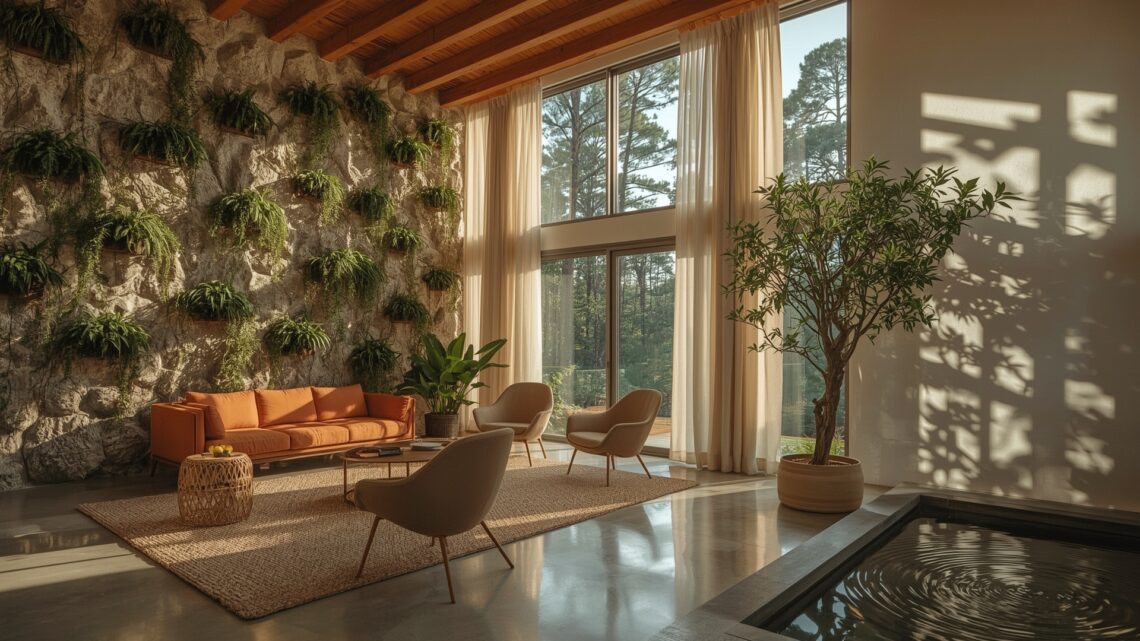
Your brain was never built for fluorescent lights, blank walls, and sealed windows. Humans evolved outdoors — surrounded by trees, water, shifting light, and open sky. When modern spaces strip all of that away, your nervous system notices. Stress rises. Focus drops. Mood suffers.
Biophilic design is the practice of bringing nature back into built environments. But it goes much deeper than adding a houseplant or painting a wall green. The real foundation is psychological. Decades of research show that specific design decisions — the view from a window, the texture of a wall, the way light moves through a room — directly affect how your brain functions and how your body feels.
This article breaks down the psychological frameworks behind biophilic design, explains why they work, and shows you how to apply them in real spaces.
Key Takeaways
- Biophilia is hardwired: Humans have an innate need for connection with nature, shaped by hundreds of thousands of years of evolution.
- Four core theories explain the psychology: Attention Restoration Theory, Stress Recovery Theory, Prospect and Refuge Theory, and the Biophilia Hypothesis each explain different mechanisms.
- Measurable outcomes exist: Nature-connected spaces reduce cortisol levels, lower blood pressure, improve cognitive performance, and accelerate recovery from illness.
- It’s not just plants: Natural light, airflow, water sounds, organic textures, and fractals all activate the same psychological responses as being outdoors.
- Every room type benefits differently: The psychological priorities for a bedroom, office, and bathroom are distinct and require targeted design strategies.
- Design attributes matter more than decorative choices: Spatial configuration, sensory layering, and visual complexity drive the deepest psychological effects.
What Is the Biophilia Hypothesis and Why Does It Matter for Interior Design?

Quick Answer: The Biophilia Hypothesis, coined by biologist E.O. Wilson in 1984, proposes that humans have an instinctive need to connect with other living systems. In interior design, this means spaces that include natural elements feel psychologically safer and more restorative than those that don’t.
E.O. Wilson argued that this affinity for nature isn’t cultural — it’s biological. Our ancestors lived in natural environments for over 200,000 years. The brain adapted to read natural cues as signals of safety, food, and shelter. Spaces that replicate those cues trigger the same positive neurological responses.
This is why you feel calmer near a window with a garden view than in a windowless conference room. It’s not preference. It’s physiology.
How Evolutionary Biology Shapes Spatial Preferences
Your brain evaluates spaces in milliseconds. It asks unconscious questions: Is this safe? Can I see threats? Is there shelter? Are there resources here? Natural environments historically answered “yes” to all of these. Environments with high ceilings, open views, soft light, and organic materials still trigger those ancient “safe” signals today.
Sterile, enclosed, artificial spaces often trigger the opposite response — low-level threat detection that keeps the nervous system slightly activated. Over time, that chronic activation contributes to fatigue, anxiety, and poor cognitive performance.
What the Research Shows
Studies across hospitals, schools, offices, and homes consistently find the same pattern: people exposed to natural elements perform better and feel better. Roger Ulrich’s landmark 1984 study found that surgical patients with a window view of trees recovered faster, used less pain medication, and had fewer complications than patients facing a brick wall.
The effect isn’t subtle. It’s measurable in cortisol levels, heart rate variability, and cognitive test scores.
What Is Attention Restoration Theory and How Does It Apply to Room Design?
Quick Answer: Attention Restoration Theory (ART), developed by Rachel and Stephen Kaplan in the 1980s, holds that natural environments restore directed attention capacity. Rooms with natural views, soft patterns, and low-demand visual stimuli allow the brain to recover from mental fatigue without effort.
Directed attention is the focused, effortful kind of thinking you use to write a report, follow instructions, or solve a problem. It depletes with use — like a muscle. When it runs out, you make mistakes, feel irritable, and struggle to concentrate. ART proposes that nature replenishes it.
Unlike a movie or a conversation, nature doesn’t demand your attention. It gently captures it. This is what the Kaplans called “soft fascination” — the low-effort engagement you feel watching leaves move in wind or clouds shift across the sky. That state allows directed attention to recover.
The Four Components of a Restorative Environment
The Kaplans identified four qualities that make an environment restorative. Good biophilic design tries to activate all four.
- Being Away: The space feels mentally distinct from everyday demands. Even a corner with plants and soft light can create this psychological shift.
- Extent: The environment feels rich and immersive enough to engage you. A single plant doesn’t do this. A full biophilic composition — varied textures, natural materials, layered greenery — does.
- Fascination: The environment holds attention without effort. Moving water, dappled light, or varied leaf shapes achieve this.
- Compatibility: The space supports what you’re there to do. A restorative bedroom design differs from a restorative focus room.
Applying ART to Home Office Design
A home office built on ART principles positions the desk to face a window or natural view. It incorporates plants with varied leaf textures within the peripheral field of vision. It uses warm, daylight-mimicking lighting rather than flat overhead fluorescents. These choices give directed attention micro-recovery opportunities throughout the workday without interrupting focus.
What Is Stress Recovery Theory and Which Design Elements Trigger It?

Quick Answer: Stress Recovery Theory (SRT), developed by Roger Ulrich in 1983, shows that natural environments trigger rapid physiological recovery from stress. Heart rate slows, blood pressure drops, and muscle tension decreases within minutes of exposure to nature or nature-mimicking design elements.
SRT works differently from ART. ART is about cognitive replenishment — restoring your ability to think. SRT is about physiological calm — reducing the body’s stress response. Both are activated by biophilic design, but through different mechanisms.
Ulrich’s research found that even passive exposure to nature imagery — not real nature, just photographs or videos of natural scenes — produced measurable reductions in stress markers. This matters enormously for design because it means you don’t need floor-to-ceiling windows or a backyard garden to get results.
Which Biophilic Elements Are Most Effective for Stress Recovery?
Not all nature-inspired elements are equally powerful for stress reduction. Research points to a clear hierarchy of effectiveness.
| Design Element | Stress Recovery Mechanism | Physiological Effect | Speed of Effect | Practical Application |
|---|---|---|---|---|
| Natural water sounds | Activates parasympathetic nervous system | Lowers cortisol, slows heart rate | 3 to 5 minutes | Indoor fountain, sound system with nature audio |
| Views of natural greenery | Reduces sympathetic nervous activation | Lowers blood pressure by 2 to 5 mmHg | 5 to 10 minutes | Window placement, potted trees, plant walls |
| Natural daylight | Regulates cortisol and melatonin rhythms | Improves mood, stabilizes sleep cycles | Cumulative over days | Skylights, light shelves, solar tubes |
| Organic textures | Tactile signal of natural safety | Reduces perceived stress levels | Immediate | Wood, stone, natural fiber textiles |
| Fractal patterns | Synchronizes with alpha brain wave states | Reduces stress by up to 60% in some studies | Under 1 minute | Patterned textiles, branching plants, carved stone |
| Natural scent | Direct limbic system stimulation | Reduces anxiety, improves mood | Immediate | Cedarwood, pine, eucalyptus diffusers or materials |
What Are Fractal Patterns and Why Do They Calm the Brain?
Fractals are repeating geometric patterns that appear at every scale — like the branching of a tree, the veining of a leaf, or the rippling of a coastline. Physicist Richard Taylor’s research found that fractals with a specific complexity range (called a fractal dimension of 1.3 to 1.5) reduce physiological stress markers by as much as 60%.
Nature is full of fractals at exactly this complexity level. When you look at a fern, a river delta, or a snowflake, your brain recognizes that pattern as inherently safe and pleasant. Biophilic interiors can replicate this through the organic shapes of plants, carved wood details, woven textiles, and irregular stone surfaces.
What Is Prospect and Refuge Theory and How Should It Shape Room Layout?

Quick Answer: Prospect and Refuge Theory, developed by geographer Jay Appleton in 1975, explains why humans prefer spaces that offer both a wide view (prospect) and a sheltered retreat (refuge). Rooms that balance these two qualities feel instinctively comfortable and safe.
On the savanna where humans evolved, survival required two things: the ability to see threats approaching (prospect) and a safe place to retreat when needed (refuge). We still carry those preferences. Spaces that deliver both feel deeply satisfying. Spaces that deliver neither — like an open, exposed office with no visual anchors — feel subtly threatening.
How Prospect and Refuge Play Out in Interior Spaces
A reading nook tucked into an alcove with a window view is the perfect prospect-refuge composition. The alcove delivers refuge — enclosure, shelter, safety. The window delivers prospect — a broad view, visual access to the environment. Together, they create a space people instinctively gravitate toward.
This is also why people consistently choose corner tables in restaurants, window seats on trains, and chairs that face the door in waiting rooms. The preference isn’t random. It’s prospect-refuge psychology in action.
Applying Prospect and Refuge to Key Rooms
| Room | Prospect Element | Refuge Element | Design Strategy | Common Mistake |
|---|---|---|---|---|
| Living Room | Open sightlines to garden or street | Low-backed sofa against a wall | Position seating to face the longest view while backed by a solid wall | Floating sofa in center with no wall anchor |
| Bedroom | Window with soft outdoor view | Bed headboard against a solid wall | Never place the bed under a window or facing an open door | Bed exposed on three sides with no solid backing |
| Home Office | Desk facing a window or open wall | Chair backed against a solid wall | Position desk so you face out, not toward a wall | Desk facing a blank wall with open space behind the user |
| Dining Room | Visual access to the rest of the home | Banquette seating or chairs against walls | Create a defined boundary around the dining zone | Fully exposed table with no surrounding enclosure |
| Reading Corner | Window or view of the room | Alcove, canopy, or partial enclosure | Use bookshelves or curtains to create a sheltered nook | Single chair in the middle of an open room |
How Does Biophilic Design Affect Mental Health Over Time?
Quick Answer: Consistent exposure to biophilic environments reduces chronic stress, lowers rates of anxiety and depression, and improves cognitive performance over weeks and months. The cumulative effect on mental health is significant because your nervous system responds to your environment continuously, not just in the moment.
A single nature walk lowers cortisol. But living and working in biophilic spaces creates a baseline shift. Your nervous system is exposed to restorative cues all day, every day. The background stress load that comes from sterile, artificial environments drops — and it stays dropped.
Research from the University of Exeter found that workers in offices with natural elements reported 15% higher wellbeing scores, 6% higher productivity, and 15% higher creativity levels compared to those in lean, undecorated spaces. These aren’t marginal improvements. They reflect meaningful changes in daily experience.
The Connection Between Natural Light and Mood
Light is the most powerful biophilic tool available. Natural daylight directly regulates the brain’s production of serotonin (a mood stabilizer) and melatonin (a sleep hormone). Poor light exposure disrupts both. The result is lower mood, disturbed sleep, and reduced cognitive function.
Spaces designed to maximize daylight penetration — through window placement, light-colored surfaces, skylights, and reflective materials — support the brain’s natural circadian rhythm. This isn’t just about feeling nice. It’s about keeping the body’s core regulatory systems functioning correctly.
Biophilic Design Across Different Mental Health Contexts
| Mental Health Context | Primary Psychological Need | Most Effective Biophilic Element | Supporting Design Feature | Expected Outcome |
|---|---|---|---|---|
| Chronic stress | Physiological recovery | Water features, natural sounds | Soft, indirect lighting | Reduced cortisol levels over 2 to 4 weeks |
| Anxiety | Sense of safety and control | Prospect and refuge spatial layout | Enclosed seating zones, clear sightlines | Lower perceived threat, calmer resting state |
| Depression | Mood regulation and stimulation | Natural daylight, living plants | Warm color temperatures (2700K to 3000K) | Improved serotonin production, elevated mood |
| Cognitive fatigue | Directed attention restoration | Soft views of greenery, natural patterns | Low-stimulation zones for micro-recovery | Improved focus capacity within 20 to 40 minutes |
| Poor sleep quality | Circadian rhythm regulation | Daylight during waking hours, darkness at night | Blackout capability, warm-toned evening lighting | Better sleep onset and sleep quality over 2 to 3 weeks |
What Sensory Dimensions Does Biophilic Design Engage Beyond the Visual?
Quick Answer: Biophilic design engages all five senses. Beyond visual nature elements, the most psychologically effective spaces incorporate natural sounds, organic textures, fresh air circulation, and nature-derived scents — each activating different restorative pathways in the nervous system.
Most people think biophilic design means plants and wood finishes. Those are visual elements. But the nervous system gathers information through every sense simultaneously. A space can look natural while still feeling sterile if it smells of synthetic materials, has no airflow, and fills the ears with HVAC hum.
True biophilic psychology requires a multi-sensory approach. Each layer adds cumulative restorative value.
The Multi-Sensory Biophilic Framework
| Sensory Channel | Natural Reference | Interior Design Application | Psychological Effect | Implementation Cost Level |
|---|---|---|---|---|
| Visual | Greenery, water, sky, sunlight | Plants, natural materials, windows, fractals | Fascination, stress recovery, attention restoration | Low to high |
| Auditory | Birdsong, running water, wind | Indoor fountains, nature soundscapes, acoustic panels | Parasympathetic activation, stress reduction | Low to medium |
| Tactile | Bark, stone, soil, grass | Rough timber, textured stone, linen, wool, rattan | Grounding, safety signaling | Low to medium |
| Olfactory | Forest, petrichor, floral, earth | Cedarwood finishes, pine diffusers, real flowers, beeswax | Direct limbic stimulation, mood elevation | Low |
| Thermal/Air | Breeze, warmth variation | Operable windows, ceiling fans, varied temperature zones | Alertness regulation, thermal comfort | Medium to high |
How Do You Apply Biophilic Psychology Principles to a Specific Room?
Quick Answer: Apply biophilic psychology room by room based on its primary function. Bedrooms need circadian light support and refuge composition. Living rooms need sensory richness and prospect balance. Home offices need attention restoration elements and directed views. Each context activates different psychological mechanisms.
Bedroom: Prioritizing Recovery and Circadian Rhythm
The bedroom’s primary psychological function is recovery — sleep, rest, and emotional reset. Biophilic design here focuses on darkness control, warm color temperature lighting (under 2700K in the evening), natural textures in bedding and flooring, and a refuge-dominant spatial layout with the bed anchored against a solid wall.
Plants that release oxygen at night — like peace lilies, snake plants, and orchids — add a subtle biophilic layer while improving air quality. Avoid high-stimulus visual elements like complex art or bright colors that compete with the brain’s need to downregulate before sleep.
Living Room: Balancing Prospect, Refuge, and Sensory Richness
The living room serves multiple functions — social connection, relaxation, and entertainment. Biophilic design here layers sensory elements: organic textures in upholstery and rugs, a clear prospect sightline toward a window or garden, and soft fascination elements like a bookcase of varied objects or a living plant grouping.
The seating arrangement should follow prospect-refuge logic — anchored furniture with clear views. A mix of refuge zones (enclosed armchairs, nooks) and open social seating serves different psychological needs within the same room.
Home Office: Designing for Cognitive Performance
Cognitive performance depends on directed attention, which depletes fastest in sterile, unstimulating environments. A biophilic home office positions the desk to face a window or a living plant arrangement. It uses daylight-spectrum lighting (5000K to 6500K during working hours) to support alertness and serotonin production.
Soft fascination elements — a small water feature on the desk, a varied plant grouping in the peripheral field of vision, a wood-grained desk surface — give the brain micro-restoration moments without breaking concentration.
What Is the Difference Between Decorative Biophilic Design and Psychologically Effective Biophilic Design?
Quick Answer: Decorative biophilic design adds natural aesthetics without engaging psychological mechanisms. Psychologically effective biophilic design is intentional — it considers spatial configuration, sensory layering, light dynamics, and restorative theory to create measurable changes in mood, focus, and stress levels.
A single succulent on a windowsill is decorative. A thoughtfully arranged composition of varied plants at different heights, in organic ceramic containers, positioned to catch morning light and sit within your peripheral vision while you work — that’s psychologically active design.
The difference is intentionality. Decorative choices are chosen for appearance. Psychological choices are chosen for effect.
Common Biophilic Design Mistakes That Undermine Psychology
- Artificial plants: Plastic foliage provides visual cues of nature but lacks the dynamic qualities — slight movement, varied light response, subtle scent — that activate restorative responses.
- Nature imagery without real elements: A photograph of a forest is less effective than a real plant. It provides weak soft fascination and no tactile, olfactory, or air-quality benefit.
- Ignoring spatial layout: Adding plants to a poorly laid-out room doesn’t compensate for violated prospect-refuge principles or poor light dynamics.
- Sensory overload: Too many competing patterns, textures, and colors — even natural ones — can overwhelm the nervous system rather than restore it.
- Disconnected lighting strategy: Plants and natural materials lose their psychological impact under cold, flat artificial lighting. Light is the context that makes everything else work.
Frequently Asked Questions
What is the difference between Attention Restoration Theory and Stress Recovery Theory?
Attention Restoration Theory focuses on mental fatigue. It explains how natural environments restore your capacity for focused, effortful thinking. Stress Recovery Theory focuses on physical stress responses — like elevated heart rate and high cortisol — and shows how nature reduces them. Both operate simultaneously in well-designed biophilic spaces, but they address different systems in the body and brain.
Do indoor plants actually improve air quality enough to affect psychology?
NASA’s Clean Air Study found that certain indoor plants can reduce airborne volatile organic compounds (VOCs). However, the volume of plants needed for meaningful air filtration in a typical room is quite high — around one large plant per 100 square feet at minimum. The more reliable psychological benefit comes from the visual and soft fascination effects of plants, which activate stress recovery and attention restoration with far fewer specimens.
Can biophilic design principles work in a basement or windowless room?
Yes, but it requires more effort. Circadian-spectrum artificial lighting (tunable LED systems that shift from 6500K during the day to 2700K in the evening) can partially replace natural daylight for mood and hormone regulation. Nature soundscapes, organic textures, water features, and living plants under grow lights all contribute restorative value without requiring windows or natural light access.
How does biophilic design relate to the concept of solastalgia?
Solastalgia is the psychological distress caused by environmental change — the grief of losing a natural place that once felt like home. Biophilic design addresses a related but distinct need: the chronic disconnection from nature in urban built environments. By reintroducing natural cues, biophilic spaces help reduce the low-grade psychological toll of nature deprivation that affects many urban residents.
What is the role of dynamic and diffuse light in biophilic psychology?
Dynamic light — light that changes in intensity or color temperature throughout the day — is far more psychologically effective than static artificial lighting. Natural daylight is never a fixed color or brightness. Your brain evolved to read those changes as time-of-day cues. Diffuse light (soft, scattered rather than harsh and directional) also mimics overcast natural conditions, which the brain reads as lower-stress environments compared to harsh spotlighting.
Is there a minimum threshold of biophilic elements needed to produce psychological benefits?
Research suggests that even minimal exposure to nature elements produces some benefit — even a window view of a single tree improves outcomes compared to no view at all. However, the deeper psychological frameworks like attention restoration and stress recovery require sustained, multi-sensory engagement to produce meaningful results. One plant is better than none. A layered biophilic composition with light, texture, greenery, and sound is significantly more effective than a single element.

