Most people buy a plant, set it on a windowsill, and call it done. But styling indoor plants is a design skill — one that transforms a room from tidy to genuinely alive. The difference between a plant that looks like an afterthought and one that anchors a space comes down to placement, proportion, and layering.
This guide covers everything from how to group plants at multiple heights to choosing planters that complement your existing decor. Whether you have one fiddle leaf fig or twenty trailing pothos, these strategies help every plant earn its spot in your home.
Key Takeaways
- Layer plants at three height levels — floor, surface, and elevated — to create visual depth in any room.
- Group in odd numbers (3, 5, or 7 plants) for arrangements that feel natural and balanced.
- Match planter material to room style — terracotta for warm or earthy interiors, ceramic for modern spaces, woven baskets for bohemian or relaxed looks.
- Use vertical plant placement on shelves, ladders, and wall-mounted systems to fill dead zones above eye level.
- Vary leaf shape and texture within a grouping to create contrast without visual chaos.
- Functional styling comes first — always match light requirements before arranging for aesthetics.
What Is Plant Styling and Why Does It Matter for Interiors?
Quick Answer: Plant styling is the intentional arrangement of indoor plants using height, grouping, and planter choices to create visual balance. It turns isolated plants into cohesive design features that improve how a room feels and looks.
A single plant sitting alone on a shelf rarely makes an impact. Plant styling changes that by treating your greenery as a design element — the same way you would a lamp, a piece of art, or a throw pillow.
When done well, styled plants draw the eye upward, soften hard architectural edges, and add a sense of organic life that no furniture piece can replicate. The goal is not to fill every corner with greenery. It is to place the right plants in the right spots with the right containers.
Interior designers often use plants as a finishing layer — the final step that makes a styled room feel complete. Understanding this perspective helps you approach your own space with more intention.
How Do You Choose the Right Plant for Each Room?
Quick Answer: Match the plant to the room’s light level first. Low-light rooms suit pothos, snake plants, and ZZ plants. Bright rooms support fiddle leaf figs, monsteras, and citrus trees. Getting the light right means the plant thrives and stays looking good longer.
Light Conditions by Room Type
Light is the one factor that cannot be styled around. A plant in the wrong light will decline quickly, no matter how beautiful the planter is.
- South-facing rooms: Direct light for most of the day. Best for succulents, cacti, fiddle leaf figs, and herbs.
- East or west-facing rooms: Bright indirect light for several hours. Best for monsteras, pothos, peace lilies, and rubber plants.
- North-facing rooms: Low, indirect light. Best for snake plants, ZZ plants, cast iron plants, and Chinese evergreens.
Plant-to-Room Scale: Getting Proportions Right
Scale is as important as light. A small succulent on the floor of a large living room disappears. A towering seven-foot fiddle leaf fig in a narrow hallway feels oppressive.
A good rule of thumb: floor plants should be at least 18 to 24 inches tall to register in a full-size room. Tabletop plants work best between 6 and 14 inches tall. Trailing plants on high shelves need at least 8 to 12 inches of vine length to create visual movement.
What Are the Best Indoor Plants for Styling Different Interior Styles?
Quick Answer: Monstera and fiddle leaf fig suit modern and mid-century interiors. Snake plants and rubber trees work in minimalist spaces. Trailing pothos and ferns complement bohemian and eclectic rooms. The plant’s silhouette and leaf scale should echo the room’s existing design lines.
Indoor Plant Styling by Interior Style — EAV Table
| Interior Style | Recommended Plants | Planter Material | Placement Priority | Key Visual Trait |
|---|---|---|---|---|
| Modern / Minimalist | Snake plant, rubber tree, ZZ plant | White or black ceramic, concrete | Single statement plant per zone | Clean lines, upright form |
| Bohemian / Eclectic | Trailing pothos, ferns, string of pearls | Woven baskets, terracotta, macramé hangers | Layered groupings, high shelves | Flowing, organic, textured |
| Mid-Century Modern | Fiddle leaf fig, monstera, bird of paradise | Ceramic on wood stands, teak planters | Corner anchors, beside furniture | Bold leaves, sculptural form |
| Scandinavian / Japandi | Peace lily, olive tree, pilea | Matte ceramic, natural stone pots | Sparse, intentional single placements | Soft green, simple profile |
| Coastal / Relaxed | Bird of paradise, palm, monstera | Rattan baskets, white ceramic | Floor clusters, open corners | Tropical, airy, oversized leaves |
| Traditional / Classic | Ficus, orchid, peace lily | Glazed ceramic, brass cache pots | Symmetrical pairs, formal placement | Refined, structured, neat |
How Do You Layer Plants at Multiple Height Levels?

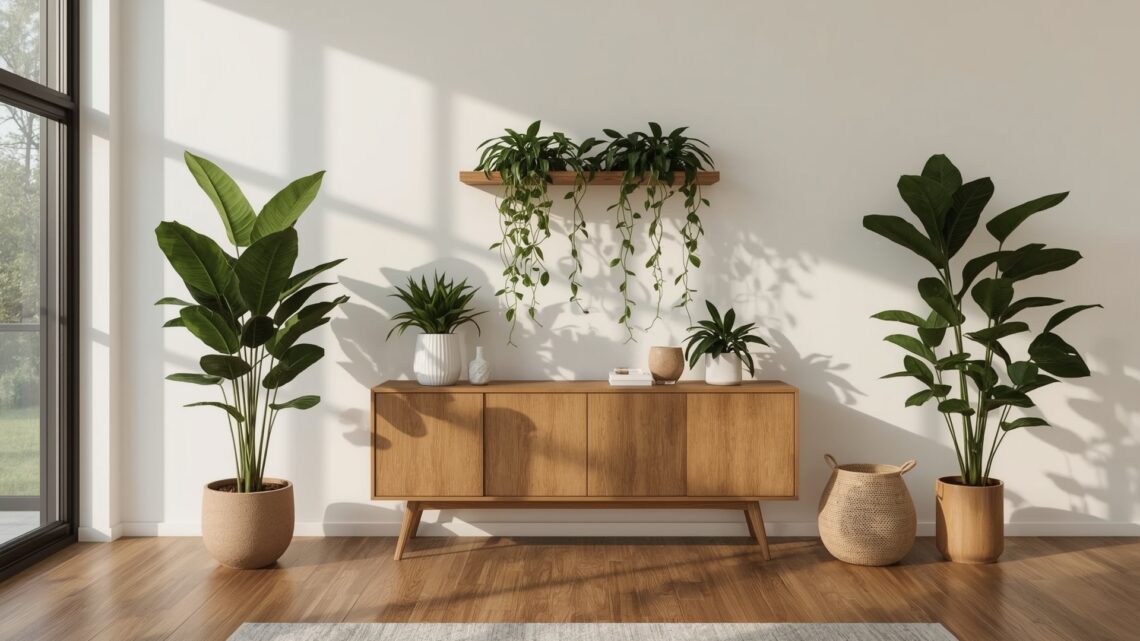
Quick Answer: Use three height zones — floor level (over 24 inches), surface level (6 to 24 inches on tables or shelves), and elevated level (trailing or hanging plants above eye level). Combining all three zones creates dimension and fills dead space in a room.
Height layering is the single most powerful technique in plant styling. It works the same way furniture arrangement works: a room needs items at different heights to feel balanced and complete.
Think of your room in horizontal bands. The floor zone anchors the space. The surface zone (furniture tops and shelves) adds middle-ground interest. The elevated zone — hanging planters, wall-mounted shelves, or tall plant ladders — draws the eye upward and makes ceilings feel taller.
Three-Zone Height Layering Framework
- Zone 1 — Floor Level (24 inches and above): Large statement plants like fiddle leaf figs, bird of paradise, monsteras, or olive trees. These anchor corners and fill empty vertical space beside sofas or beds.
- Zone 2 — Surface Level (6 to 24 inches): Medium plants on coffee tables, console tables, bedside tables, bookshelves, and kitchen counters. Examples: pothos, peace lily, pilea, succulents, small rubber trees.
- Zone 3 — Elevated Level (above eye level): Trailing plants in hanging planters or on high shelves, wall-mounted planters, macramé hangers, or plants on top of cabinets. Examples: string of hearts, trailing pothos, spider plants, string of pearls.
Plant Height and Placement Reference — EAV Table
| Plant | Mature Height | Best Zone | Light Requirement | Growth Rate |
|---|---|---|---|---|
| Fiddle Leaf Fig | 5–10 ft indoors | Floor | Bright indirect, 6+ hrs | Slow to moderate |
| Bird of Paradise | 4–8 ft indoors | Floor | Bright direct or indirect | Slow |
| Monstera Deliciosa | 3–8 ft indoors | Floor / Surface | Bright indirect | Moderate to fast |
| Snake Plant | 1–4 ft indoors | Floor / Surface | Low to bright indirect | Slow |
| Pothos | Trails 4–10 ft | Elevated / Surface | Low to bright indirect | Fast |
| String of Hearts | Trails 2–4 ft | Elevated | Bright indirect | Moderate |
| Pilea Peperomioides | 8–12 inches | Surface | Bright indirect | Moderate |
| ZZ Plant | 2–4 ft | Floor / Surface | Low to medium indirect | Slow |
What Are the Best Plant Grouping Strategies for a Styled Look?

Quick Answer: Group plants in odd numbers (3, 5, or 7) and vary them by height, leaf size, and texture. Place taller plants at the back, medium plants in the middle, and low or trailing plants at the front. This layered triangle shape feels natural and balanced.
Odd-number groupings work because the eye cannot equally divide them. You naturally look from one plant to another, which creates flow. Even-number groupings tend to feel static or overly formal unless you are going for a symmetrical, traditional look.
How to Build a Plant Grouping Step by Step
- Pick a focal plant. Choose the tallest or most visually striking plant. This is your anchor — everything else supports it.
- Add a mid-height plant. Place it beside the focal plant, slightly in front or to one side. It should be noticeably shorter.
- Add a low or trailing element. This can be a small succulent, a trailing plant at the base, or a ground-level pot tucked in front.
- Vary leaf shapes. Mix large bold leaves (monstera, philodendron) with fine-textured plants (ferns, grass-like sedge) to avoid a flat look.
- Unify with planters. Choose pots in the same color family or material family. This holds the grouping together visually without making it look matchy.
Grouping Variables to Contrast and Repeat
- Contrast: Leaf size (large vs. small), leaf shape (round vs. spiky), height (tall vs. low)
- Repeat: Planter color, planter material, overall color palette of foliage
- Avoid: All plants the same height, all plants the same leaf shape, all different planter materials with no unifying element
How Do You Use Vertical Space for Indoor Plant Styling?
Quick Answer: Use plant ladders, wall-mounted shelves, hanging planters, and tall plant stands to activate vertical space. Vertical plant placement fills dead zones above furniture, makes rooms feel taller, and lets you style more plants without using floor area.
Most people underuse the upper half of their walls. Vertical plant styling solves two problems at once: it adds greenery in rooms where floor and surface space is limited, and it creates visual interest above the standard furniture sightline.
Vertical Placement Methods and When to Use Them
- Plant ladders: Freestanding ladder shelves let you display 3 to 6 plants at graduated heights in one footprint. Best for living rooms, bedrooms, and home offices. Works with trailing and small upright plants.
- Floating wall shelves: Mounted shelves create a gallery-style display. Work best with small to medium plants and decorative objects. Keep at least 12 inches between shelves to allow plant growth.
- Hanging planters: Suspend from ceiling hooks or curtain rods. Best for trailing plants like pothos, string of hearts, and spider plants. Position 18 to 24 inches below the ceiling for safety and visual breathing room.
- Macramé hangers: Add a textural element along with the plant. Suit bohemian, relaxed coastal, or eclectic interiors. Best near windows for light access.
- Top-of-cabinet styling: Place trailing plants on top of kitchen cabinets or wardrobes. The vines cascade down naturally over months, creating a built-in living element.
- Plant stands of varying heights: Metal, wood, or bamboo stands at 12, 24, and 36 inches allow you to position any plant at any height without permanent fixtures.
How Do You Choose Planters That Complement Your Interior?
Quick Answer: Match planter material to your room’s existing finishes. Terracotta suits warm, earthy, or Mediterranean interiors. Ceramic or concrete works in modern and minimalist rooms. Woven baskets complement natural, bohemian, or coastal styles. The planter is part of the design — it is not just a pot.
Planter Materials, Styles, and Interior Fit — EAV Table
| Planter Material | Interior Style Fit | Drainage Quality | Weight | Price Range (per pot) | Best Plant Types |
|---|---|---|---|---|---|
| Terracotta | Mediterranean, earthy, bohemian | Excellent (porous) | Medium | $5–$30 | Succulents, herbs, cacti |
| Glazed ceramic | Modern, traditional, eclectic | Good (if drilled) | Heavy | $20–$120 | Pothos, peace lily, orchids |
| Concrete | Industrial, minimalist, Scandinavian | Poor (needs drainage hole) | Very heavy | $25–$80 | Snake plant, ZZ plant |
| Woven basket / rattan | Bohemian, coastal, relaxed | Used as cache pot only | Light | $15–$60 | Any plant with inner nursery pot |
| Fiberglass | Modern, commercial, outdoor-to-indoor | Good (if drilled) | Light | $40–$200 | Large floor plants, trees |
| Wood (teak or cedar) | Mid-century, Japandi, Scandinavian | Moderate (liner needed) | Medium | $30–$150 | Ferns, orchids, small trees |
| Self-watering plastic | Functional / hidden in larger cache pot | Built-in reservoir system | Light | $10–$40 | All plant types |
The Cache Pot Method
A cache pot is a decorative outer container with no drainage hole. You keep your plant in its functional nursery pot (the plastic one it came in) and slip it inside the cache pot. This is the easiest way to use baskets, ceramic pots, or any container without worrying about drainage.
Always leave a small gap at the base so roots never sit in pooled water. Check for standing water every time you water and empty it within 30 minutes.
What Are the Most Common Plant Styling Mistakes to Avoid?
Quick Answer: The biggest mistakes are placing a single plant in isolation, ignoring scale, using all the same height, overcrowding surfaces, and choosing planters that clash with room finishes. Each of these mistakes reduces the visual impact of even healthy, well-chosen plants.
Styling Mistakes and Their Fixes
| Mistake | Why It Fails | The Fix |
|---|---|---|
| Isolating one plant per room | Single plants rarely create visual weight | Group 3 plants at different heights |
| All plants at the same height | Flat arrangement with no depth | Apply the three-zone height framework |
| Wrong plant scale for the room | Small plants in large rooms disappear | Use floor plants (24+ inches) as anchors |
| Mismatched planter materials | Visual chaos with no cohesion | Stick to one or two materials per grouping |
| Ignoring light requirements | Plants decline, losing their styled effect | Match plant to light zone before styling |
| Overcrowding surfaces | Rooms feel cluttered, not designed | Leave at least 30% of surface area open |
How Do You Style Plants in Small Spaces and Apartments?

Quick Answer: In small spaces, prioritize vertical placement over floor arrangements. Use wall shelves, hanging planters, and window ledges to maximize greenery without using floor area. Choose compact plants like pilea, small rubber trees, or trailing pothos in hanging pots.
Small spaces actually benefit more from thoughtful plant styling than large rooms do. A well-placed plant grouping can make a compact apartment feel warmer and more layered without adding furniture or visual clutter.
Small-Space Plant Styling Techniques
- Window ledges: Use a deep windowsill or add a narrow shelf across the window frame. This puts plants where the light is strongest without sacrificing floor space.
- Vertical wall shelf columns: Stack two or three floating shelves at different heights on one wall. This creates a plant moment without pulling any furniture from the room.
- Hanging from curtain rods: Clip S-hooks to a curtain rod and hang small planters. This works in windows and keeps trailing plants near their light source.
- Over-door shelf units: Command-hook shelf systems above doorframes hold small lightweight plants without drilling.
- Under-window console tables: A narrow console below a south or east-facing window gives you both surface and floor zone styling in one spot.
How Do You Style Plants Room by Room?
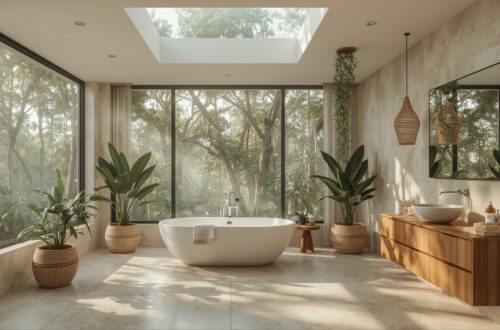
Quick Answer: Each room has different light conditions, humidity levels, and visual roles for plants. Living rooms suit large floor anchors and grouped displays. Bedrooms benefit from calming low-light plants. Kitchens work well with herbs and trailing plants near windows. Bathrooms support humidity-loving ferns and pothos.
Room-by-Room Plant Styling Recommendations — EAV Table
| Room | Best Plant Choices | Styling Priority | Placement Zone | Light Consideration |
|---|---|---|---|---|
| Living Room | Fiddle leaf fig, monstera, rubber tree | Anchor corners, create grouped displays | Floor + surface | Bright indirect preferred |
| Bedroom | Snake plant, peace lily, pothos | One or two calm, simple plants | Surface + floor | Low to medium indirect |
| Kitchen | Herbs, trailing pothos, small succulents | Functional and decorative near windows | Surface + elevated | Bright south or east window |
| Bathroom | Fern, pothos, orchid, air plants | Use humidity; keep off toilet areas | Surface + wall-mounted | Low light with humidity boost |
| Home Office | ZZ plant, pilea, small monstera | One desk plant, one floor anchor | Surface + floor | Indirect light near desk |
| Entryway / Hallway | Snake plant, cast iron plant, fern | Tall plant for impact in narrow space | Floor | Often low light — choose accordingly |
How Do You Keep Styled Plants Looking Good Long-Term?
Quick Answer: Rotate plants a quarter turn every two to four weeks so all sides receive even light. Wipe large leaves monthly with a damp cloth to remove dust, which blocks light absorption. Remove yellowed or dead leaves immediately. Repot when roots are circling the drainage holes or pushing out of the soil.
A styled plant that is struggling looks worse than having no plant at all. Maintenance is what keeps the design working long-term. The good news is that basic care habits take about five minutes per plant per week.
Seasonal Plant Styling Adjustments
Plant growth slows significantly in winter (October through February in the Northern Hemisphere). During this period, reduce watering frequency and avoid repotting or major moves. This is also when low-light plants like snake plants and ZZ plants are most useful, as shorter daylight hours reduce available light across all rooms.
In spring and summer, fast-growing plants like pothos and monsteras can add several inches per month. Plan your groupings with growth in mind — leave room for trailing plants to expand downward and bushy plants to spread outward.
Frequently Asked Questions About Styling Indoor Plants
How many plants should be in one room?
There is no fixed rule, but a comfortable starting point is three to five plants per medium-sized room (around 200 to 300 square feet). Group them in one or two arrangements rather than scattering them individually. Quality placement beats quantity every time.
Can you mix real and artificial plants in the same grouping?
You can, but it works best when the artificial plant is not the focal plant. Use high-quality artificial plants as filler at the back of a grouping where they are less scrutinized. Avoid mixing if the room gets close-range inspection, like a dining table centerpiece.
What is a cache pot and do you need one?
A cache pot is a decorative outer container that holds a plant still in its nursery pot. It has no drainage hole, so you use the nursery pot for watering and just slip it inside for display. Cache pots give you design flexibility without committing to repotting, and they let you swap plants in and out of stylish containers easily.
How do you style plants on open shelves without looking cluttered?
Follow the 60/40 rule: cover about 60% of each shelf with objects (plants, books, decorative items) and leave 40% open. Mix plant heights with books and sculptural objects to create visual rhythm. Avoid lining plants in a single straight row — stagger them at different depths on the shelf.
Which plants work best as floor anchors in large rooms?
Fiddle leaf figs, bird of paradise, olive trees, areca palms, and large rubber trees are the most effective floor anchors for large rooms. Look for plants with a mature indoor height of at least four feet and a strong visual silhouette. Place them in corners or beside furniture to frame the space rather than block foot traffic.
Do planter colors need to match the room’s color palette?
They do not need to match exactly, but they should not fight the palette. Neutral planters (white, beige, terracotta, charcoal, natural wood) integrate into almost any room without conflict. Bold-colored pots work well as intentional accent pieces if the room already uses that color somewhere — in a cushion, a rug, or artwork.